Blog
Return to Blog »
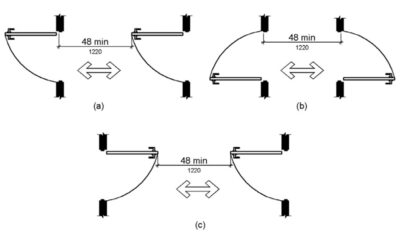
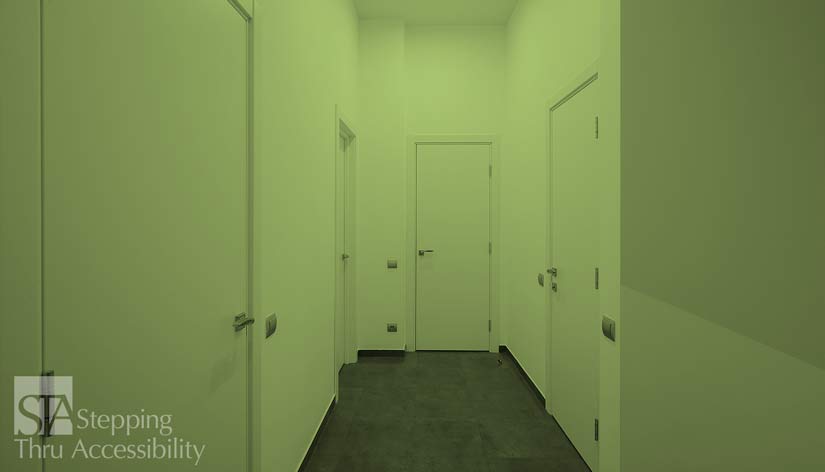
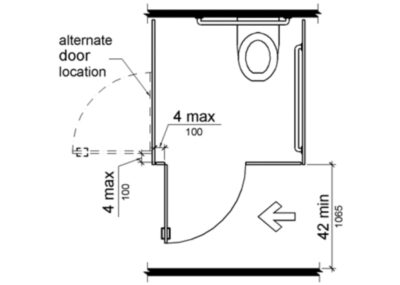
Janis Kent, Architect, FAIA, CASp © January, 2026 I have recently received several calls and emails from people asking for assistance with clarifications. Most of them have discussed the issues with their colleagues but they were not comfortable with the consensus arrived at. Although these were each about different portions of the codes/regulations, they were all centered around interpreting the illustrations in the codes and regulations leading to confusion. For instance, one had to do with the toilet compartment door in a multi-user toilet room – the opening being 4″ maximum from the adjoining wall or partition. The question was – since the illustrations show it as 4″ from the hinge side, is that a requirement? Now if we look at the actual wording, it does not state that – just 4″ to the door opening location. 604.8.1.2 Doors. …Doors shall be located in the front partition or in the side wall or partition farthest from the water closet. Where located in the front partition, the door opening shall be 4 inches (100 mm) maximum from the side wall or partition farthest from the water closet. Where located in the side wall or partition, the door opening shall be 4 inches (100 mm) maximum from the front partition… So the opening can be 4″ from the strike side as well. In this instance, the issue comes into play that the pull side would need 18″ clear, which it would not achieve with an in-swinging door to the compartment. And it would not achieve the 12″ push strike side clearance with a full-height out-swinging door with the required closer in a typical framed wall. But as long as the door has the required clearances, it is 4″ to the opening on either side. In my opinion, I think the diagram was just easier to show the one condition, but one has to always overlay the other portion of codes and regulations. Another item that has come up was how to measure door heights – in other words where do you measure from-to. Under section 404 Doors, Doorways, and Gates it clearly states that you can have 78″ measured from the finished floor or ground to the door stop. 404.2.3 Clear Width. Door openings shall provide a clear width of 32 inches (815 mm) minimum. Clear openings of doorways with swinging doors shall be measured between the face of the door and the stop, with the door open 90 degrees. Openings more than 24 inches (610 mm) deep shall provide a clear opening of 36 inches (915 mm) minimum. There shall be no projections into the required clear opening width lower than 34 inches (865 mm) above the finish floor or ground. Projections into the clear opening width between 34 inches (865 mm) and 80 inches (2030 mm) above the finish floor or ground shall not exceed 4 inches (100 mm). EXCEPTIONS: 1. In alterations, a projection of 5/8 inch (16 mm) maximum into the required clear width shall be permitted for the latch side stop. 2. Door closers and door stops shall be permitted to be 78 inches (1980 mm) minimum above the finish floor or ground. I am hearing that in certain jurisdictions, for public housing, they are interpreting this to mean a mechanical device door stop attached to a closer. It does not state that at all. One would presume that it is referencing the anatomy of the door casing which keeps it from over-swinging. This section, though, is talking about door clear widths and specifically states one measures the clear width between the face of the door and its stop. In this case it would be the vertical piece attached to the casing that prevents the door from over-swinging. In both of these scenarios, it is talking about the clear dimension to the stop attached to the casing, not to any other type of buy-out product that would prevent a door from over-swinging. Furthermore, the regulations also state that doorways are a component of an Accessible Route under 402.2. When we look at 307 Protruding Objects, we can see the requirements for clear height of an accessible route is 80″, but there is an exception at a door closer and at a door stop 307.4 Vertical Clearance. Vertical clearance shall be 80 inches (2030 mm) high minimum. Guardrails or other barriers shall be provided where the vertical clearance is less than 80 inches (2030 mm) high. The leading edge of such guardrail or barrier shall be located 27 inches (685 mm) maximum above the finish floor or ground. EXCEPTION: Door closers and door stops shall be permitted to be 78 inches (1980 mm) minimum above the finish floor or ground. If an opening does not have a door stop, then we would presume it requires 80″ minimum clear height to the casing. And one other thing to note, in the 2025 CBC under Means of Egress, section 1010.1.1 has more information on size. Section 1010.1.1.1 Projections into Clear Opening, exception 1 has been particularly added, which states: Exceptions: 1. Door closers, overhead doorstops, frame stops, power door operators, and electro-magnetic door locks shall project into the door opening height not lower than 78 inches above the floor. Basically it states one measures the clear height from the finished floor or ground to the door closer or stop. So the confusion is – what is the door stop that the regulations are referring to? My guess is it the the same type of strip that you measure the door clear width, that continues along the top which is a part of the casing. There is not reason to interpret it in any other manner. And all are in agreement, that one measures to the finished floor not the top of the threshold. Another item that came up was regarding doors in series particularly in public housing. People tend to interpret doors in series by the diagram – similar to a vestibule or across from each other in a hallway. But is that the definition of doors in series? Generally it would mean going thru one door and then sequentially, a following door, but it is not better defined. I have heard people say it does not apply to residential units in public housing. Or that if one door has a closer and there is space to move away, then it would be okay. But we get back to the words…and a lack of a real definition. For Residential Dwelling Units, the mobility feature units are to comply with the general chapter on Accessible Routes. 809.2 Accessible Routes. Accessible routes complying with Chapter 4 shall be provided within residential dwelling units in accordance with 809.2 When we get to Chapter 4 on Accessible Routes, it includes doorways. 402.2 Components. Accessible routes shall consist of one or more of the following components: walking surfaces with a running slope not steeper than 1:20, doorways, ramps, curb ramps excluding the flared sides, elevators, and platform lifts. All components of an accessible route shall comply with the applicable requirements of Chapter 4. Now that we are in Chapter 4, we can look at doors in series. 404.2.6 Doors in Series and Gates in Series. The distance between two hinged or pivoted doors in series and gates in series shall be 48 inches (1220 mm) minimum plus the width of doors or gates swinging into the space. Nowhere does it state anything about closers. Nowhere does it state that the doors have to be opposite each other in order for it to be considered ‘in series’. And nowhere does it state it is required to be in a vestibule. The only item that it states is the minimum distance between pivoting/hinged doors, which allows you to go thru one door before opening the other. I think the issue is that there is no definition for ‘doors in series’ nor does it state that this is specifically limited to a vestibule. The Access Board has published something a bit different, stating if there is enough space to move beyond one door before opening the next then it is acceptable and that travel thru both doors is required – but that contradicts the diagrams provided (and shown above), and this is not what the approved regulations actually state, it is their interpretation. So do be careful when relying on it. In my opinion, I would say that if you need/want to go thru one door and then another, then those two doors can be interpreted as doors in series. But, if we have 2 doors, one into a men’s and another adjacent door into a women’s toilet room and the area has less than 48″ from each other, that would not be ‘doors in series’ since one generally does not go into the woman’s toilet room from the men’s. Also be aware, that under the CBC for the adaptable units (which include the communication feature units) it states: 11B-809.6 Residential Units with Adaptable Features… 11B-809.8 Doors. Primary entry doors, required exit doors, secondary exterior doors and interior doors shall comply with Section 11B-809.8… 4. Doors in series shall comply with Section 11B-404.2.6. But the bottom line with all of these discrepancies is – under the 2010 ADA Standards as well as the 2025 CBC (11B-104.3) it states: 104.3 Figures. Unless specifically stated otherwise, figures are provided for informational purposes only. ICC A-117.1 105.4 it also states something with similar language. So be aware. This means one has to review and rely on the words. That is what the requirements are – the words, unless that section specifically references a diagram in the regulations and in the codes. Many times we want to interpret something to our liking and sensibility, but we always need to go back to the actual words in order to determine what is required. Be aware that your local City or County may have additional requirements that are more restrictive than the State or Federal requirements. Also, this article is an interpretation and opinion of the writer. It is meant as a summary – current original regulations should always be reviewed when making any decisions. © Janis Kent, Architect, FAIA, CASp January, 2026Diagrams and Illustrations in the Codes & Regulations
A. Toilet Compartment Doors
B. Door Clear Heights
C. Doors In Series